
It’s hard to watch someone you care about slip, and harder still to know what to say. Learning how to save a life through suicide prevention starts with a few skills anyone can pick up.
You start by learning to spot the signs. That awareness leads you to ask the direct question, and to stay present while they answer. None of it requires a clinical background. It takes attention, a little courage and knowing where to turn. Below, we’ll walk through exactly what to look for and what to say.
- Call or text 988 to reach the Suicide and Crisis Lifeline, available 24 hours a day.
- Prefer not to talk? Chat with the Lifeline online.
- If someone has already attempted suicide, call 911 or your local emergency number.
What to Do When Someone Needs Help Right Now
The scale of the problem is easy to underestimate. According to the Centers for Disease Control and Prevention (CDC), an estimated 14.3 million adults seriously thought about suicide in 2024, 4.6 million made a plan and 2.2 million attempted it.
If that’s the moment you’re in right now, here’s where to start:
- Call or text the 988 Suicide and Crisis Lifeline, day or night
- Chat online through the Lifeline’s website if a phone call feels like too much
- In an emergency, call 911 or your local emergency number if someone has already attempted suicide
- Stay with them until help arrives and keep talking
Warning Signs You Shouldn’t Brush Off
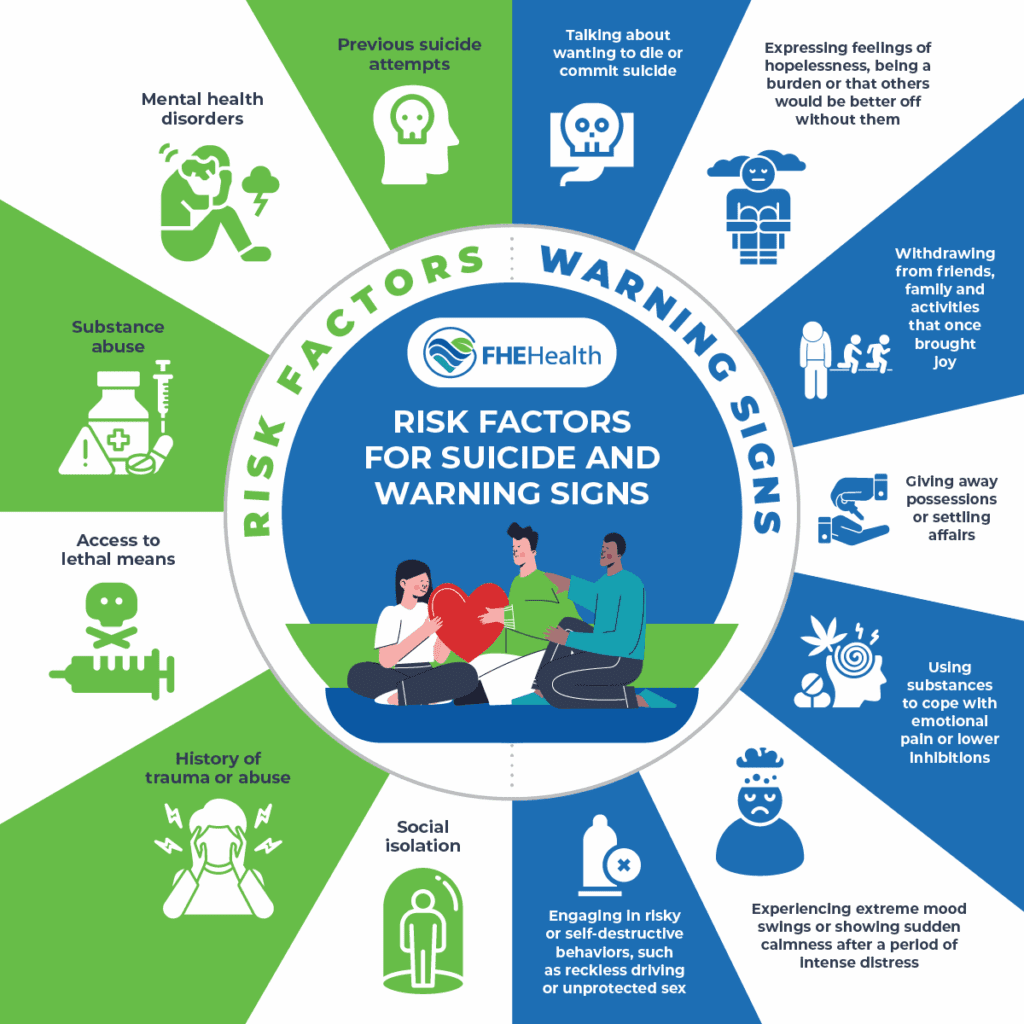
People rarely reach a crisis point overnight. Most move through a slower period of suicidal thinking first, and that period often comes with warning signs and risk factors, even when the person tries hard to hide them. A chronic health condition or an existing mental health diagnosis can raise the risk further. In adults, watch for:
- Agitation, anger or anxiety that feels out of character
- Sudden sleep changes, too little most nights or too much on others
- Talk of feeling trapped, or in pain with no way out
- Mentions of suicide or self-harm, even in passing
- Reckless behavior that wasn’t there before
- Mood swings that feel extreme
- Comments about being a burden to family or friends
- New or heavier drinking and drug use
- A sense of hopelessness, or saying there’s no reason to keep going
- Pulling away from people they used to lean on
Warning Signs in Children and Teens
Kids and teens often show something different. Look for a sudden belief that the future holds nothing good, or sleep that’s thrown off balance.
Headaches and stomachaches with no clear cause can show up too, alongside sudden irritability that wasn’t there before. Withdrawal shows up here as well, along with a kind of exhaustion that rest doesn’t seem to fix. School grades slipping, or a favorite activity losing its appeal overnight, can point in the same direction.
One or two of these signs on their own don’t necessarily mean someone is at risk. A repeated pattern is what’s worth bringing up.
How to Bring up Suicide With Someone You Love
Once you notice the signs, the next step is starting the conversation. Most people don’t know where to start, especially given how sensitive the topic can feel. These six steps are here to make that part easier.
1. Find the Right Time and Place
Your loved one will open up more easily when they feel settled rather than cornered. Wait for a quiet stretch, and find a private spot where they won’t feel watched. Face-to-face works best, since tone and body language get lost in a text thread. When that’s not possible, a video call beats a phone call, and a phone call beats typing it out. Even ten unhurried minutes can be enough, as long as neither of you feels rushed toward the door.
2. Start With an Opening About Yourself
Rather than starting with a question aimed at them, open with what you’ve noticed. Starting there keeps the door open, instead of a question that puts them on the defensive. A few openers that work:
- “I’ve been thinking about you a lot lately…”
- “I noticed you haven’t seemed like yourself…”
- “I’ve been worried about you…”
- “I saw what you posted the other day…”
- “I feel like maybe you’ve been struggling recently…”
3. Ask Direct Questions
Once you get the conversation moving, the next step is to ask plainly. A question like “Are you thinking about suicide?” feels blunt, but it won’t plant the idea in their head. What it does is show them you’re not afraid of the word, and that gives them room to answer honestly. Some people respond better to a softer opening, like “Do you want to talk about what’s going on?” Either way, plain language beats a hint or a half question.
4. Use Plain Language Over Slang
Plain language means calling it what it is. Skip slang terms like “unalive” or “off yourself,” even if that’s what you hear online or from friends. Those terms started as ways to dodge platform filters, and they can make suicide sound smaller than it is. Use the word “suicide.” It might feel heavy to say out loud, but that directness shows you understand the weight of what they’re carrying.
The same applies when you’re talking about someone who has died. “Died by suicide” is the accurate phrasing. “Committed suicide” carries an echo of crime and adds shame to a conversation that doesn’t need any more of it.
5. Give Them Room to Talk
Once you’ve asked, stop talking. This is the part that trips people up more than any other step. Silence feels awkward, and people often feel the urge to fill it, but you shouldn’t.
When they’re talking, nod along and let your face show you’re still with them. Neither of you needs to say a word for a while. A simple “take your time, I’m listening” gives someone room to find their words without feeling rushed. If they pause, don’t jump in with a question or a guess; just let the pause sit there. Most people need that space before the real answer comes out, and rushing them can send it right back under.
6. Ask Follow-Up Questions
By now the conversation has some momentum, and a few more questions will keep it moving. Each answer fills in a piece of the picture, and that picture tells you how urgent things really are.
- “How long have you been feeling this way?”
- “Have you had these thoughts before?”
- “Have you told anyone else about this?”
- “Do you have a plan?”
- “How can I support you right now?”
That fourth question matters most. A specific plan usually means the risk sits higher than you thought. If the answer is yes, don’t leave them alone. Call or text 988 together, or make the call yourself while you stay with them, and stay until someone else is there.
Need Help?
Treatment can begin quickly and discreetly, get started now
What Support Looks Like After the Conversation
The hardest conversation is behind you, but ongoing support matters just as much in the days that follow. Ask what would help, and then let your answer show up in small, repeated ways rather than one grand gesture.
- Follow through when you say you’re available, whether that means a phone call at an odd hour or just sitting nearby in silence
- Point to specific things they’ve added to your life, since a broad “you matter” tends to fade fast
- With their okay, bring in a few more people you both trust, so no single person carries the weight alone
Alongside that, a clinical layer matters. As many as 90% of people who experience suicidal thoughts have a mental health condition, something a licensed therapist or psychiatrist is trained to identify and treat. Offer to help find one, and if it feels right, sit with them through that first visit.
How FHE Health Can Help
Recovery Month, observed each September, exists to remind people that healing stays possible no matter how dark things have gotten, and that same idea applies when suicidal thoughts enter the picture. When warning signs show up in someone you love, the right support can change where things go from here. At FHE Health, our team works with people carrying suicidal thoughts alongside depression, substance use or both, and builds each plan around the person rather than a fixed script.
If you’re ready to talk through what care could look like, for you or for someone you love, reach out to FHE Health today.