Never underestimate the role of family in addiction recovery. That’s the takeaway from a large body of research that helps explain why high-quality rehab providers will, whenever possible, involve family in the treatment process. But just what is the nature of healthy participation in a loved one’s recovery, and how might it differ from the roles family members may have previously played in enabling an addiction?
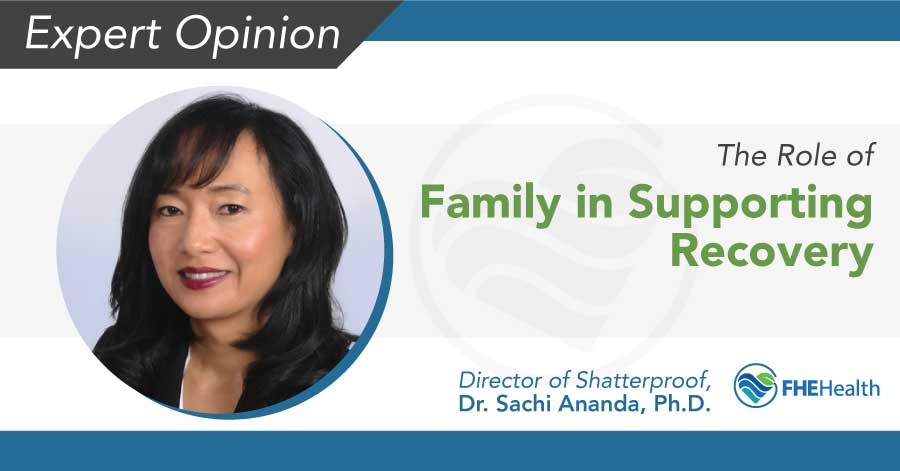
We put these questions and others before Dr. Sachi Ananda, Ph.D. As the program director of FHE Health’s Shatterproof FHE Health program, a treatment track for first responders, Dr. Ananda is intimately acquainted with the family dynamics of addiction and, specifically, the link between substance use and family roles. She and her staff regularly serve as a resource to families who want to support their loved one’s recovery but don’t know how. What follows are her insights for anyone who wants to play a positive role in their family member’s recovery from drugs or alcohol.
How Involving Family in Treatment Can Improve Recovery Outcomes
“Family involvement is absolutely necessary in a loved one’s recovery,” Dr. Ananda said. She added that “it’s critical for someone in recovery to have a support system they can turn to,” because “addiction is a family disease, meaning that it’s not just the one member’s issue, it’s the dynamics of the whole family and how well it’s functioning.”
In this sense, when one person in a family has an addiction, it isn’t their health problem alone. It’s “a sign there’s something wrong with the family system and that it’s out of balance,” according to Dr. Ananda.
Describing addiction as a family disease doesn’t mean relatives caused the addiction or are responsible for curing it. The term recognizes how substance use affects relationships throughout the household.
SAMHSA’s Treatment Improvement Protocol 39 describes how family systems influence how people communicate and respond to problems. When addiction affects one person, other family members often change their behavior to cope. Some adjustments help, while others create unhealthy patterns.
Research supports involving families in addiction treatment when it’s appropriate and the person receiving care agrees. Family participation may encourage individuals to engage with treatment and increase the likelihood of sustaining long-term recovery.
The need for treatment remains substantial. SAMHSA’s 2025 National Survey on Drug Use and Health found that 44.6 million people ages 12 and older, or about 15.3% of that population, had a substance use disorder. Yet only about 16% of people who needed substance use treatment received it.
How Family Can Support Addiction Recovery
What can the family do to support someone in recovery? Get educated about addiction, Dr. Ananda said, because with greater understanding comes the empowerment to help rather than hurt a loved one’s recovery:
When a family member takes the time to understand addiction and what drives the addictive behavior, they can then help support their loved one better. Rather than blaming the person for not being strong enough or being weak-minded because they can’t get off of a substance, they understand that addiction is a more complex, bio-psycho-social disorder. And it’s not that someone wants to be addicted, it’s just there are many factors that have contributed to their disorder.
Family Roles in Addiction
Family roles are among the “many factors that have contributed to [a loved one’s] disorder.” When asked to address what family roles and family dynamics enable addiction and create obstacles to recovery, Dr. Ananda was quick to preface her answer with the observation that today, no family is immune to addiction.
“In this day and age, unfortunately, every family has the risk of somebody developing an addiction, because of the stress of society and the lack of connection between people,” she said.
“That being said,” Dr. Ananda went on to note that “a dysfunctional family would have a higher risk of having an addicted loved one, especially if there’s a risk of rescuing their loved one from the consequences of their drug or alcohol use. If you have that rescuer person who wants to minimize the negative effects, then that person with the addiction will continue to use [drugs or alcohol], because they can; and someone is going to clean up their mess and they don’t have to face the reality of their mess.”
The rescuer role is thus a common trap family members fall into, dragging their loved one with them. While it’s tempting to think that, by helping a loved one avoid the negative consequences of their actions, they’re helping the situation, rescuers are in fact pushing their loved one further away from the motivation to seek treatment. After all, if someone continues to be shielded from the full fallout of their self-destructive habit, they’ll have little incentive to quit and the same cycle of addiction will continue.
When it’s someone you love struggling with substance use, it can be hard to distinguish between helping them and protecting them from the consequences of addiction.
Supporting recovery means encouraging positive decisions while respecting your loved one’s independence. Enabling involves actions that unintentionally allow harmful behavior to continue. For example, driving them to a treatment appointment is supportive, while calling their employer with a false excuse for an absence related to substance use is enabling.
Need Help?
Treatment can begin quickly and discreetly, get started now
Start the Conversation
Talking about addiction can feel uncomfortable, particularly when previous conversations have ended in arguments. Here, Dr. Ananda emphasized that “family members can and should be supportive of their [loved one’s] process,” but she also cautioned against taking on a managerial role: “Addicts are notorious for being averse to authority … The [worst] thing a family member can do is tell the addict how to manage their recovery.”
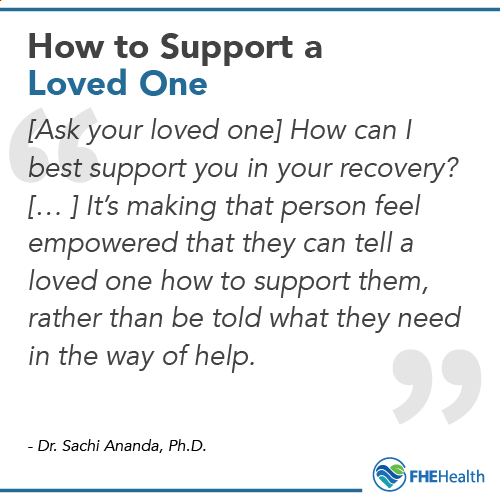
A better approach, according to Dr. Ananda: Ask your loved one, “How can I best support you in your recovery?” … “It’s making that person feel empowered that they can tell a loved one how to support them, rather than be told what they need in the way of help.” The help is then an invitation rather than an imposition.
Open-ended questions allow your loved one to explain what support they want. You can start by asking:
- What would help you feel supported right now?
- How would you like me to respond if I’m worried about your recovery?
- Would you feel comfortable talking about what we should do if things become difficult?
Try to listen without immediately offering solutions.
Also, “family members need to know it’s not their recovery,” Dr. Ananda said. “The best thing they can do is work on themselves and make sure they’re doing self-care for themselves rather than obsessing about the other person’s recovery.”
How to Understand One’s Role in a Loved One’s Recovery
While self-care and healthy boundaries are critical to playing a positive role in a loved one’s recovery, “getting educated about addiction and recovery” remains equally important. For example, with more understanding about the nature of addiction and its impact on family systems, family members are better positioned to “understand that if they have anxiety about their loved one’s recovery, being anxious for them doesn’t help them.”
Similarly, “if you’re wanting to be the person who is monitoring your loved one’s every move to make sure they’re not engaging in addictive behaviors, that type of monitoring is codependency,” Dr. Ananda said. The goal is to “be an added support, not the person the addict depends on for their recovery.”
Relapse Warning Signs and When to Intervene
Healthy support of a loved one’s recovery can also entail intervening “as soon as possible” when you have good reason to believe your loved one is imminently at risk of relapse. Here, Dr. Ananda gave the disclaimer that “hopefully you will have already had the conversation where the person in recovery has invited you to point out their relapse warning signs.”
Among the “red flags” signaling relapse may be: “if your loved one says ‘I don’t want you to help me,’ ‘I can do this on my own,’ or, ‘I just want things to go back to normal.'”
The following warning signs may also indicate that it’s time to intervene, Dr. Ananda said:
- “There’s not an understanding of the importance of reaching out for help. (If that happens, all you can do is set your own boundaries with the person, because they didn’t invite you to help them.)”
- If your loved one committed to going to support group meetings and isn’t going
- If your loved one is lying about what they’re doing and covering up
If your loved one agrees, consider establishing the following arrangements:
- Identify changes in behavior your loved one wants you to raise.
- Agree on a calm, private way to discuss concerns.
- Decide who to contact if additional professional support becomes necessary.
- Establish a safety plan for situations that require urgent assistance.
Discussing potential warning signs before problems arise helps everyone understand when support is welcome.
Family involvement in addiction treatment looks different for everyone. Some family members take part in honest conversations with treatment professionals, while others focus on offering support at home.
At FHE Health, we offer family support resources alongside our addiction treatment programs. When a patient signs a release of information, their FHE therapist reaches out to family.
Support for the Family
Helping someone recover from addiction can be tough emotionally. You might feel responsible for how they’re doing or worry about your own feelings. It’s important to get support for yourself too.
Many organizations are dedicated to helping relatives and friends affected by addiction. They offer resources designed for your specific challenges. You don’t have to wait for your loved one to start treatment before seeking support.
- Al-Anon provides peer support for people affected by someone else’s drinking.
- Nar-Anon supports families that are dealing with a loved one’s drug addiction.
- SMART Recovery Family & Friends gives relatives practical tools for clear communication and setting healthy boundaries. These tools help families support both their loved ones and themselves.
Our team also provides family support resources to help relatives better understand addiction and recovery.
Families of first responders deal with unique challenges. Traumatic events and unpredictable schedules can put extra strain on relationships at home.
According to SAMHSA, about 30% of first responders develop behavioral health conditions such as post-traumatic stress disorder (PTSD) and depression, compared with 20% of the general population. These problems can affect their partners and families too.
Our Shatterproof FHE Health program provides specialized addiction and mental health treatment for first responders and recognizes the importance of supporting their families. We also provide additional support through our Stronger Together program, a weekly support group for spouses and significant others of Shatterproof FHE Health patients. Participants can connect with others who understand the pressures their families experience.
Need Help?
Treatment can begin quickly and discreetly, get started now
Frequently Asked Questions
Supporting Recovery Together
Supporting a loved one through addiction recovery requires patience, but you’re not alone on this journey. The caring team at FHE Health is here to walk you through your options and help you choose the best path forward. Reach out today and discover how we can stand beside your family.