• Skip to primary navigation
  • Skip to main content
  • Skip to primary sidebar
  • Skip to footer

FHE Health | Residential Rehab & Mental Health Center in Florida Homepage

Drug, Alcohol and Mental Health Treatment

ContactCareers

Call for Immediate Help (833) 596-3502

  • About
        • About FHE Rehab
          • About FHE Health
          • Our Staff
          • Testimonials
          • #FHE25
        • Our Campus
          • Gallery
          • Our Videos
          • Our Services
          • Health & Wellness Center
        • Careers at FHE Health
          • Employment Opportunities
        • Our Expertise
          • Accreditations
          • Educational Opportunities
          • Community Impact Award
          • First Responder Families Podcast
          • First Responder Paws
          • Education Scholarship
  • Addiction
        • Treatment Programs
          • Alcohol Addiction
          • Addiction Treatment
          • Behavioral Addiction
        • Levels of Care
          • Continuum of Care
          • Addiction Detox
          • Residential Addiction Treatment
          • Outpatient Addiction Treatment
        • What We Treat
          • Alcoholism
          • Amphetamines
          • Benzodiazepines
          • Cocaine
          • Heroin
          • Opioids
          • Sedative
  • Mental Health
        • Mental Health Rehab
          • Mental Health Services
          • Onsite Psychiatric Care
          • Dual Diagnosis
        • Levels of Care
          • Residential Mental Health Care
          • Outpatient Mental Health Care
        • What We Treat
          • ADD & ADHD
          • Anxiety Disorders
          • Bipolar Disorder
          • Depression
          • Eating Disorders
          • Personality Disorders
          • PTSD
          • Schizophrenia
          • Trauma
  • Programs
        • FHE Programs
          • Specialty Program Overview
          • Restore (Mental Health)
          • Shatterproof FHE Health
            (First Responders & Veterans)
          • Empower! (Women's Substance Use)
          • Compass (Men's Substance Use)
        • Support Programs
          • Alumni
          • Family Support
        • Therapies
          • Acupuncture
          • Breathwork Therapy
          • CBT (Cognitive Behavioral Therapy)
          • DBT (Dialectical Behavioral Therapy)
          • EMDR Therapy
          • Expressive Arts Therapy
          • Evidence-Based Treatment
          • Individual Therapy
          • Group Therapy
          • Gambling Therapy
          • Trauma-Informed Care
        • Medical Care
          • Medical Integration
          • Ketamine Infusion
          • IV Vitamin
          • Fitness & Nutrition
          • Medication-Assisted Treatment
          • Medication Management Services
          • Transcranial Magnetic Stimulation (TMS)
        • NeuroRehab Services
          • Neuro Rehabilitation
          • Neurofeedback Training
          • Neurostimulation Therapy
          • qEEG Brain Mapping
          • Insomnia Treatment for PTSD
  • Resources
        • FHE Guides
          • Understanding Drug Abuse
          • Signs of Addiction
          • The Disease of Addiction
          • Confronting Addiction
          • Staging an Intervention
          • Rehab Success Rate – Does It Really Work?
          • Withdrawal Timelines
          • Life After Rehab
          • LGBTQ+ Community Resources
          • Veteran Resources
          • Remote Resources Toolkit
        • FHE Health Resources
          • FHE Podcasts
          • Our Surveys
          • FHE News
          • All Articles
  • Admissions
        • Insurance
          • Will Insurance Cover Treatment?
          • Blue Cross Insurance
          • Beacon Health / Value Options Insurance
          • Cigna Insurance
          • Humana Insurance
          • TRICARE Insurance
          • VA Community Care
        • Admissions
          • Admissions
          • Discharge Planning
          • Steps to Addiction Help
          • Self-Pay Rehab
          • Treatment Schedules
        • FAQ
          • Frequently Asked Questions
          • Keeping Your Job in Rehab
          • Example Day in Rehab
        • Contact Admissions
          • Contact Us
          • Secure Payment Form
  • Contact
  •  
Home > Featured in Commentary > National Substance Abuse Prevention Month: How to Protect Your Family

By: Chris Foy | Last Updated: October 1, 2026

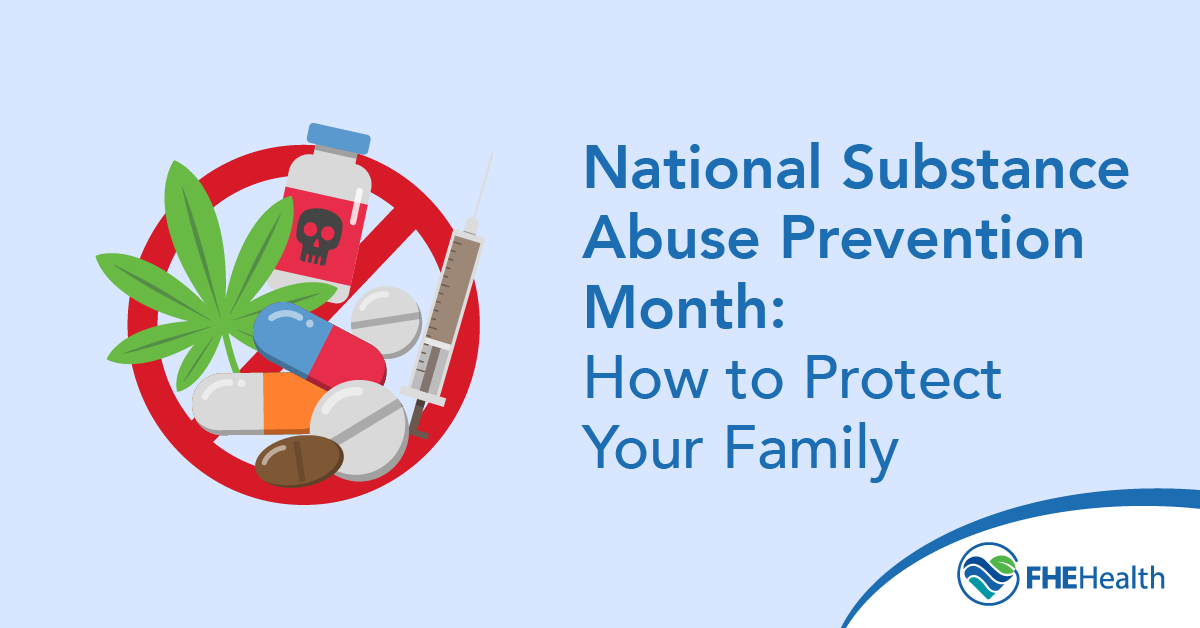
National Substance Abuse Prevention Month: How to Protect Your Family

What is national substance abuse prevention month

Substance use prevention focuses on reducing factors that increase the likelihood of problematic substance use while strengthening protective factors such as family connection, healthy coping skills, education and early support. Families can help by talking openly about alcohol and drugs, setting clear expectations, watching for meaningful changes in behavior and seeking professional help when concerns arise.

October is National Substance Abuse Prevention Month, an opportunity to focus on preventing substance misuse before it develops into a more serious problem. SAMHSA now recognizes the observance as Substance Use & Misuse Prevention Month. Effective substance use prevention involves understanding why people may turn to substances and recognizing when someone needs additional support.

Substance Use in America: Current Numbers

The scale of substance use disorders (SUDs) shows why prevention remains important. According to the latest available National Survey on Drug Use and Health (NSDUH), 48.4 million Americans aged 12 and older, or 16.8% of that population, had an SUD in 2024. Among young adults ages 18 to 25, the rate was 25.9%. About 2 million adolescents ages 12 to 17 had an SUD during the same year.

These numbers don’t mean substance use disorder is inevitable. They highlight the value of understanding risks early and creating conditions that can make substance misuse less likely.

Risk Factors for Substance Abuse

There is no single reason why someone develops an SUD. NIDA describes risk and protective factors that operate across individual, family, peer, school and community levels. Some factors can change over time, while others cannot.

Risk may be influenced by:

  • Genetic predisposition or a family history of addiction
  • Mental health concerns
  • Adverse childhood experiences or chronic stress
  • Peer groups in which substance use is common
  • Easy access to alcohol or drugs
  • Low perception of the risks associated with substance use
  • Family conflict or a lack of consistent support

Having one or several risk factors doesn’t mean a person will develop an addiction. Instead, these factors can help families understand where additional support may be useful.

Protective Factors That Reduce Risk

Protective factors can counter some risks and support healthier development and decision-making. Factors such as positive self-image and self-control may play a protective role. Prevention can also work across families, schools, peer groups and communities.

At home, practical protective steps can include:

  • Maintaining regular communication
  • Setting age-appropriate expectations around substance use
  • Taking an interest in children’s friendships and activities
  • Making room for healthy outlets for stress, including exercise, hobbies, creative activities and supportive relationships

Mental health deserves attention as part of prevention. Substance use and mental health conditions can overlap, making early support for anxiety, depression, trauma or other concerns particularly important.

Early Warning Signs to Watch For

Warning signs vary, and one change in behavior doesn’t prove that someone is misusing substances. Patterns and unexplained changes are more useful to pay attention to.

In teenagers, concerns might include sudden changes in friends, falling grades, unexplained absences, secrecy, loss of interest in usual activities or significant changes in sleep and mood. Adults may begin missing responsibilities, withdrawing from family, experiencing financial problems or repeatedly using substances despite negative consequences.

At work, frequent unexplained absences, declining performance, unusual behavior or repeated safety problems may raise concerns. However, these signs can have many causes. They should prompt a conversation rather than an accusation.

FHE Health’s guide to the signs of addiction provides more detail on behavioral and physical changes that may warrant attention.

Need Help?

Treatment can begin quickly and discreetly, get started now

Contact Us

Having the Conversation About Substances With Family

You don’t need a perfect speech. In fact, ongoing conversations are usually more useful than one dramatic family meeting.

Choose a calm moment. Ask open questions and listen to the answers. With teenagers, discuss what they already know about alcohol, vaping, prescription medications and illicit drugs. Correct misinformation without turning the discussion into a lecture. Be clear about expectations, but make it equally clear that asking for help will not result in rejection or shame.

With an adult family member, focus on what you’ve observed. “I’ve noticed you’re missing work and drinking more often” is more constructive than applying a label or trying to force an admission.

When to Seek Professional Support

Prevention also means responding when early concerns become harder to manage alone. Consider professional guidance when substance use is becoming more frequent, affecting relationships or responsibilities, creating safety concerns or continuing despite harmful consequences.

Professional assessment can help determine what’s happening and what level of support is appropriate. When substance use occurs alongside mental health symptoms, comprehensive care can also address both concerns rather than treating them as unrelated problems.

FHE Health provides individualized behavioral health and substance use treatment, with different levels of care based on each person’s clinical needs.

Need Help?

Treatment can begin quickly and discreetly, get started now

Contact Us

How to Participate in National Substance Abuse Prevention Month

October can be a useful prompt to bring prevention into everyday family life. Parents and families can:

  • Review how medications and alcohol are stored at home
  • Learn current warning signs
  • Start age-appropriate conversations with their children
  • Share reliable prevention resources, such as SAMHSA’s prevention month toolkit
  • Support local schools or community organizations that provide substance use education

Most importantly, don’t treat prevention as something that ends when October does. Family connection, honest communication, healthy coping strategies and early intervention matter throughout the year.

Frequently Asked Questions

What is substance use prevention?
Substance use prevention includes strategies designed to prevent or delay substance use and reduce the likelihood that misuse will develop into an SUD.
When is National Substance Abuse Prevention Month?
National Substance Abuse Prevention Month takes place every October. SAMHSA now recognizes the observance as Substance Use & Misuse Prevention Month. It is a prompt for families to learn about risk factors, strengthen protective factors and start conversations about substance use.
Can parents prevent their child from developing an addiction?
No strategy can guarantee that a child will never develop an SUD. Parents can, however, strengthen protective factors by maintaining open communication, setting clear expectations, supporting mental health and responding early when concerning changes appear.
What should I do if I suspect a family member is using drugs?
Start with a calm, private conversation based on specific behaviors you’ve noticed. Avoid accusations or threats. Consider seeking an assessment from a qualified behavioral health professional.

Make Prevention an Ongoing Family Priority

National Substance Abuse Prevention Month is a reminder that families don’t have to wait for a crisis before talking about substance use. Learning the risks, strengthening protective factors, noticing changes early and making it safe to ask for help can all contribute to prevention.

If substance use is already affecting you or someone you love, prevention may need to give way to treatment. FHE Health offers evidence-based, individualized care for substance use and co-occurring mental health concerns. Contact FHE Health confidentially to learn more about treatment options and the next steps toward recovery.


Filed Under: Featured in Commentary, FHE Commentary

More Questions about Treatment?

More Questions about Treatment?

We offer 100% confidential and individualized treatment

Contact Us

About Chris Foy

Chris Foy is a content manager and webmaster for FHE Health with years of experience in the addiction treatment industry...read more

Primary Sidebar

The Experience Blog

  • Addiction News
  • Alumni
  • Community Events
  • Expert Columns
  • FHE Commentary
  • FHE News
  • Treatment Legislation
  • All Articles

Sign up for the Blog

Our Facilities

Take a look at our state of the art treatment center.

View Our Gallery

Learning Center

  • Help for You
  • Help For Loved Ones
  • Help For Alcoholism
  • Help With Substance Abuse
  • Behavioral & Mental Health
  • Life in Recovery
  • Rehab Explained
  • All Articles
Contact Us
  • Call Now:
  • Best Time to Call:

Footer

FHE Health

© 2026 FHE Health

505 S Federal Hwy #2,
Deerfield Beach, Florida 33441
1-833-596-3502
Open 24 Hours Daily
youtube facebook instagram linkedin twitter
  • Contact
  • Careers
  • AI Policy
  • Privacy Policy
  • Sitemap
A+ BBB and Top Places to Work - Sun Sentinel

Copyright © 2026 · FHE Theme On Genesis Framework · WordPress · Log in

Manage Consent
To provide the best experiences, we use technologies like cookies to store and/or access device information. Consenting to these technologies will allow us to process data such as browsing behavior or unique IDs on this site. Not consenting or withdrawing consent, may adversely affect certain features and functions.
Functional Always active
The technical storage or access is strictly necessary for the legitimate purpose of enabling the use of a specific service explicitly requested by the subscriber or user, or for the sole purpose of carrying out the transmission of a communication over an electronic communications network.
Preferences
The technical storage or access is necessary for the legitimate purpose of storing preferences that are not requested by the subscriber or user.
Statistics
The technical storage or access that is used exclusively for statistical purposes. The technical storage or access that is used exclusively for anonymous statistical purposes. Without a subpoena, voluntary compliance on the part of your Internet Service Provider, or additional records from a third party, information stored or retrieved for this purpose alone cannot usually be used to identify you.
Marketing
The technical storage or access is required to create user profiles to send advertising, or to track the user on a website or across several websites for similar marketing purposes.
  • Manage options
  • Manage services
  • Manage {vendor_count} vendors
  • Read more about these purposes
View preferences
  • {title}
  • {title}
  • {title}

The FHE Health team is committed to providing accurate information that adheres to the highest standards of writing. If one of our articles is marked with a ‘reviewed for accuracy and expertise’ badge, it indicates that one or more members of our team of doctors and clinicians have reviewed the article further to ensure accuracy. This is part of our ongoing commitment to ensure FHE Health is trusted as a leader in mental health and addiction care.

If there are any concerns about content we have published, please reach out to us at marketing@fhehealth.com.

833-596-3502

Text/Call Me