
• Skip to primary navigation
  • Skip to main content
  • Skip to primary sidebar
  • Skip to footer

FHE Health | Inpatient Rehab & Mental Health Facility in Florida Homepage

Drug, Alcohol and Mental Health Treatment

ContactCareers

Call for Immediate Help (833) 596-3502

  • About
        • About FHE Rehab
          • About FHE Health
          • Our Staff
          • Locations We Serve
          • Testimonials
          • #FHE25
        • Our Campus
          • Gallery
          • Our Videos
          • Our Services
          • Health & Wellness Center
        • Our Locations
          • Alcohol Rehab
          • Detox Center
          • Drug Rehab
          • Mental Health Center
          • Outpatient Rehab
        • Careers at FHE Health
          • Employment Opportunities
        • Our Expertise
          • Accreditations
          • Educational Opportunities
          • Community Impact Award
          • First Responder Families Podcast
          • First Responder Paws
          • Education Scholarship
  • Addiction
        • Treatment Programs
          • Treatment Program Overview
          • Alcohol Addiction
          • Drug Addiction Treatment
          • Behavioral Addiction
        • Levels of Care
          • Continuum of Care
          • Addiction Detox
          • Inpatient Addiction Treatment
          • Outpatient Addiction Treatment
        • What We Treat
          • Alcoholism
          • Amphetamines
          • Benzodiazepines
          • Cocaine
          • Heroin
          • Opioids
          • Sedative
  • Mental Health
        • Mental Health Rehab
          • Mental Health Rehab
          • Onsite Psychiatric Care
          • Dual Diagnosis
        • Levels of Care
          • Residential Mental Health Care
          • Outpatient Mental Health Care
        • What We Treat
          • ADD & ADHD
          • Anxiety Disorders
          • Bipolar Disorder
          • Depression
          • Eating Disorders
          • Personality Disorders
          • PTSD
          • Schizophrenia
          • Substance Use Disorder
          • Trauma
  • Programs
        • FHE Programs
          • Specialty Program Overview
          • Restore (Mental Health)
          • Shatterproof FHE Health(First Responders)
          • Empower! (Women's Substance Use)
          • Compass (Men's Substance Use)
        • Support Programs
          • Alumni
          • Family Support
        • Therapies
          • Acupuncture
          • Breathwork Therapy
          • CBT (Cognitive Behavioral Therapy)
          • DBT (Dialectical Behavioral Therapy)
          • EMDR Therapy
          • Expressive Arts Therapy
          • Individual Therapy
          • Group Therapy
          • Gambling Therapy
        • Medical Care
          • Medical Integration
          • Ketamine Infusion
          • IV Vitamin
          • Fitness & Nutrition
          • Medication-Assisted Treatment Program
          • Medication Management
        • NeuroRehab Services
          • Neuro Rehabilitation
          • Neurofeedback Training
          • Neurostimulation Therapy
          • EEG Brain Mapping
          • Insomnia Treatment for PTSD
  • Resources
        • FHE Guides
          • Understanding Drug Abuse
          • Signs of Addiction
          • The Disease of Addiction
          • Confronting Addiction
          • Staging an Intervention
          • Rehab Success Rate – Does It Really Work?
          • Withdrawal Timelines
          • Life After Rehab
          • LGBTQ+ Community Resources
          • Veteran Resources
          • Remote Resources Toolkit
        • FHE Health Resources
          • FHE Podcasts
          • FHE News
          • All Articles
  • Admissions
        • Insurance
          • Will Insurance Cover Treatment?
          • Blue Cross Insurance
          • Beacon Health / Value Options Insurance
          • Cigna Insurance
          • Humana Insurance
          • TRICARE Insurance
        • Admissions
          • Admissions
          • Steps to Addiction Help
          • Self-Pay Rehab
        • FAQ
          • Frequently Asked Questions
          • Keeping Your Job in Rehab
          • Example Day in Rehab
        • Contact Admissions
          • Contact Us
          • Secure Payment Form
  • Contact
  •  
Home > Learning > Help For Loved Ones > On Eggshells: How to Treat a Loved One in Recovery

By: Meghan | Last Updated: October 30, 2024

On Eggshells: How to Treat a Loved One in Recovery

Walking on eggshells - what to do when a loved one is in recovery

Updated 10/30/24

The day you’ve been hoping for is finally here: Your loved one has made the decision to go to rehabilitation. After months or even years of begging, pleading and staging interventions, the message has hit home and getting help is the only step left.

Despite the initial feelings of elation triggered when a friend or loved one with an addiction finally makes the choice to get clean, the weeks to follow may be awkward or uncomfortable. You may feel lost as to how to proceed, and you may have trouble knowing what to say or how to act. You might even feel as though you’re walking on eggshells.

However, as the adage goes, knowledge is power. The more you know about the rehabilitation process and the best ways to interact with those in recovery, the more prepared you will be to support your loved one during this critical time.

Understanding the Reality of Recovery
How to treat a loved one in recovery - Understanding addictionRehabilitation isn’t a magic process. Your loved one won’t enter a program and come out a few weeks later happy, healthy and ready to embrace sobriety.

Recovery is a lifelong journey, and the first several months are often the hardest. The process of getting well isn’t quick, either: from detox to the conclusion of outpatient programs, most recovering substance users in rehab spend three to six months engaged in ongoing treatment. Your loved one may not come home immediately following time in inpatient rehabilitation, either, choosing instead to live in a sober house while completing partial hospitalization and intensive outpatient programs. He may also take up new hobbies, surrender previous pastimes or change preferences regarding everything from dining choices to recreational destinations.

All these choices may be hard to understand from the outside looking in, but these changes are a normal part of leaving a toxic lifestyle behind. As recovery progresses, it’s your job to stay involved, accept these deviations to identity as they come and stay positive about successful steps forward.

What Does the Path to Sobriety Look Like?

In spite of the individualized road individuals must follow when pursuing recovery, it’s important for you as a member of your loved one’s support system to understand the basic steps. When you are aware of where your loved one is and what’s to come, it’s easier to stay engaged in their progress.

These are the common steps in a continuum of care that you should know about:

Detox

Detox is often the first step in the process and lasts three to seven days. In this time, participants work through the side effects of physical withdrawal under the supervision of medical professionals.

Inpatient treatment

Inpatient treatment, often called residential treatment, involves living full-time in a rehabilitation center while receiving group and individual counseling and other therapies designed to promote recovery. Activities may be restricted at this time, with limits imposed on recreational activities and contact with the outside world. Inpatient treatment often lasts three to five weeks.

Partial hospitalization programs

After successfully completing an inpatient program, most recovering addicts go on to a PHP or an outpatient program that involves around eight hours of treatment five days a week. Participants can live at home or in a sober living house during this time.

Intensive outpatient programs

IOPs are a step down from a PHP, requiring three hours of treatment five days a week or five hours of treatment three days a week. Some programs allow for a choice between daytime and nighttime programming to allow for integration back into a job or family life.

Alumni care

Treatment doesn’t stop when rehabilitation ends. Those in recovery will always stay involved in the addiction community, attending 12-step meetings or participating in sober activities to remain committed to the end goal.

Responding to Your Loved One

If you want to support your loved one, staying in contact is important. Due to the delicate nature of recovery, it’s not uncommon for people to pull away, leaving recovering substance users feeling isolated and alone. When speaking to or interacting with your loved one on the journey to a sober life, keep these tips in mind.

Do:
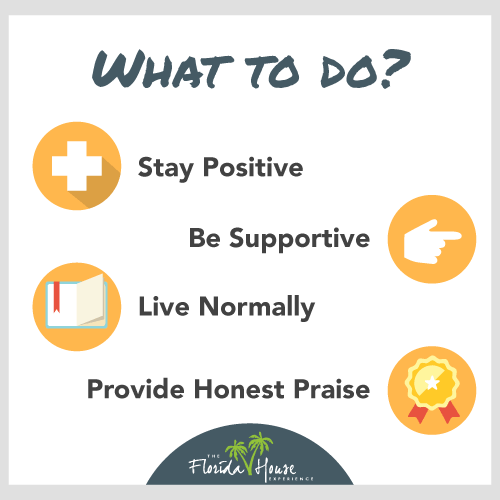
  • What to do around the loved ones with recoveryStay positive. There’s no need to be overly enthusiastic or unusually happy about interactions with your loved one, but do focus on the good things happening today rather than the bad things that happened in the past.
  • Be supportive. Even if your loved one chooses to spend more time alone while in treatment, provide consistent reminders of your presence and willingness to help. Don’t be offended if the terms of your relationship change in those early days; instead, make sure you’re always available to talk.
  • Provide honest praise. There’s no need to go too far with your praise, but don’t be afraid to let your loved one know you’re proud of them for making the choice to get help. Only 2.5 million of the roughly 21 million in need of treatment actually follow through, so your loved one has already taken incredible steps in the right direction.
  • Avoid situations in which substances play a central role. While it’s okay to invite your loved one to a restaurant that serves alcohol, it’s not okay to invite them to a kegger or a party where drug use will be rampant. This behavior fails to take into account the challenges of recovery and may be seen as offensive or problematic.
  • Live normally. Someone in recovery isn’t a fragile doll at risk of breaking. Your loved one is still, underneath it all, the same person, and your behavior should reflect this. If you used to have a standing coffee date, for example, keep this going after treatment concludes. Normalcy is important to recovery, so the more you can do, the better.

Don’t:

  • Constantly ask for status updates. Recovery is not an easy process, and the time and energy dedicated to getting clean can be immense. Repeated requests for updates can feel like undue pressure, adding further stress to the process of recovery. It’s okay to check in, but make this an occasional thing, not a regular point of conversation.
  • Make disparaging comments about relapse. Even though addicts don’t want to relapse, it does indeed happen, and it may happen to your friend or family member. Instead, remain positive and stay encouraging about signs of positive growth.
  • Talk positively about substance use. If your loved one was, for example, an alcoholic, telling stories about your own drunken antics isn’t productive. Keep the conversation clean.

If you or someone you love is struggling with addiction, getting help isn’t easy. At FHE Health, we are committed to helping those living with a substance use disorder to get clean, offering access to comprehensive programming and a dedicated continuum of care. Please contact us today to learn more about our addiction treatment opportunities.


Filed Under: Help For Loved Ones

About Meghan

Meghan Blackford is a Social Media Consultant with over ten years of advertising and digital marketing experience, who helps curate... read more

Primary Sidebar

Learning Center

  • Help for You
  • Help For Loved Ones
  • Help For Alcoholism
  • Help With Substance Abuse
  • Behavioral & Mental Health
  • Life in Recovery
  • Rehab Explained
  • All Articles

Sign up for the Blog

Our Facilities

Take a look at our state of the art treatment center.

View Our Gallery

The Experience Blog

  • Addiction News
  • Alumni
  • Community Events
  • Expert Columns
  • FHE Commentary
  • FHE News
  • Treatment Legislation
  • All Articles

Footer

FHE Health

© 2026 FHE Health

505 S Federal Hwy #2,
Deerfield Beach, Florida 33441
1-833-596-3502
youtube facebook instagram linkedin twitter
  • Contact
  • Careers
  • AI Policy
  • Privacy Policy
  • Sitemap
A+ BBB and Top Places to Work - Sun Sentinel

Copyright © 2026 · FHE Theme On Genesis Framework · WordPress · Log in

Manage Consent
To provide the best experiences, we use technologies like cookies to store and/or access device information. Consenting to these technologies will allow us to process data such as browsing behavior or unique IDs on this site. Not consenting or withdrawing consent, may adversely affect certain features and functions.
Functional Always active
The technical storage or access is strictly necessary for the legitimate purpose of enabling the use of a specific service explicitly requested by the subscriber or user, or for the sole purpose of carrying out the transmission of a communication over an electronic communications network.
Preferences
The technical storage or access is necessary for the legitimate purpose of storing preferences that are not requested by the subscriber or user.
Statistics
The technical storage or access that is used exclusively for statistical purposes. The technical storage or access that is used exclusively for anonymous statistical purposes. Without a subpoena, voluntary compliance on the part of your Internet Service Provider, or additional records from a third party, information stored or retrieved for this purpose alone cannot usually be used to identify you.
Marketing
The technical storage or access is required to create user profiles to send advertising, or to track the user on a website or across several websites for similar marketing purposes.
  • Manage options
  • Manage services
  • Manage {vendor_count} vendors
  • Read more about these purposes
View preferences
  • {title}
  • {title}
  • {title}
Questions?

We’re here to Listen & Help.
Chat with us 24/7

Contact Us
Call (833) 596-3502


The FHE Health team is committed to providing accurate information that adheres to the highest standards of writing. If one of our articles is marked with a ‘reviewed for accuracy and expertise’ badge, it indicates that one or more members of our team of doctors and clinicians have reviewed the article further to ensure accuracy. This is part of our ongoing commitment to ensure FHE Health is trusted as a leader in mental health and addiction care.

If there are any concerns about content we have published, please reach out to us at marketing@fhehealth.com.

833-596-3502

Text/Call Me