The fact is that addiction isn’t something that can be “fixed” or “cured” — recovery demands a lifelong approach to treatment. This is why 12-step groups like AA and NA emphasize that even when members have been sober for decades, continued adherence to their principles is important to maintain sobriety. And yet, within society, some people in active addiction treat the disease as if it has a simple cure. Rehab is considered a pit stop to be used after hitting “rock bottom,” which will fix the issue so that life can continue.
Although addiction cannot be cured, it can be treated effectively with a comprehensive approach to the disease. This treatment requires more than a one-time stay at a detox facility. At FHE Health in Deerfield Beach, Florida, we provide a full continuum of care to our clients, giving them the best opportunities for a new, better life — free from their behavioral and mental health issues.
What Is the Continuum of Care?
Broadly, the continuum of care describes the process of treating addiction and behavioral health in the most complete and effective way. It summarizes the standards of treatment that are proven to be the most effective: care should take place over a significant period of time and ease clients back into independent life. The continuum of addiction care is the general name for a process that starts with a check-in to a residential rehab facility and tapers with outpatient treatment — it describes the levels of addiction care. While this may be the end of a facility’s direct involvement in rehabilitation, effective addiction treatment continues after this with community support.
Additionally, there is a medical definition of what the continuum of care really means, set out by the American Society of Addiction Medicine (ASAM).
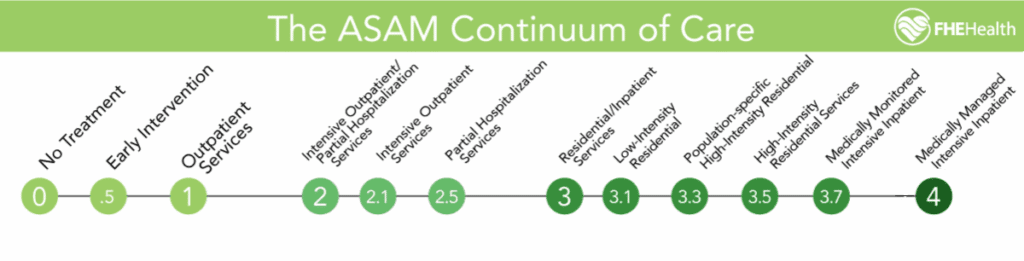
The ASAM Levels of Care for Addiction
ASAM has established codes for each step of the continuum as a way to standardize how addiction treatment is described. No two rehab facilities address clients in the exact same ways, so ASAM’s definitions make it easier to compare services across facilities. This makes billing easier for insurers, but it also provides guidance to the addiction treatment community on the most effective ways to assess and treat patients at each level. The scale ranges from 0 to 4, with 0 signifying no treatment at all, and 4 being the highest level of care in the industry.
Level 1: Outpatient Services
According to ASAM criteria, outpatient services consist of treatments and therapies administered to patients with addiction who are not residents of a facility. For care to be considered outpatient at level 1, patients must spend less than 9 hours at the treatment facility during a given week.
Level 2: Intensive Outpatient (IOP) or Partial Hospitalization (PHP) Programs
Level 2 involves services where patients are not residents of a facility but still spend a significant amount of time at a location receiving therapies and treatment that support recovery.
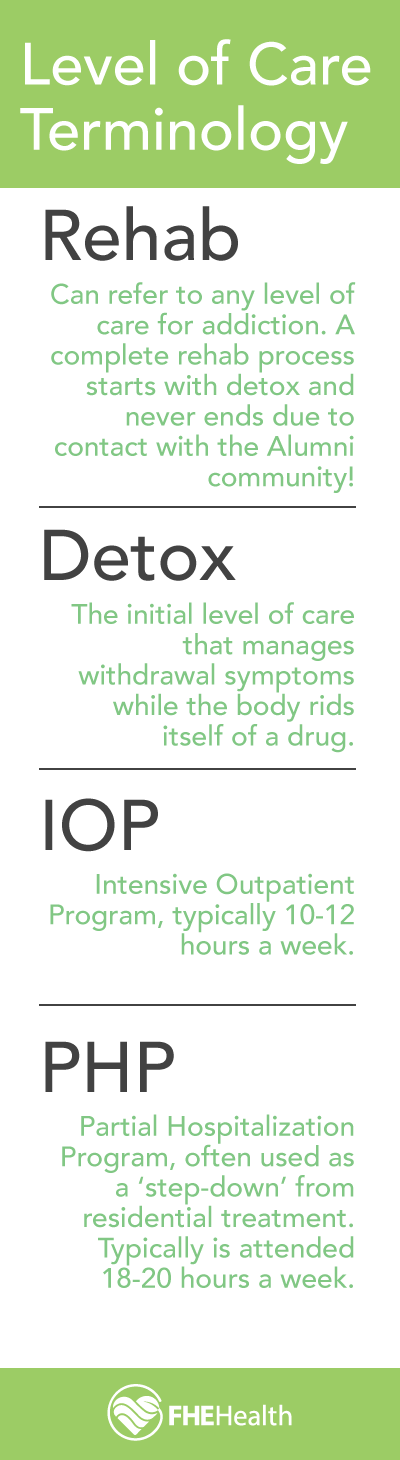
Level 2.1 is IOP, which is more than 9 hours of intervention. According to ASAM, many of these programs take place before or after work or school so that patients can receive treatment while integrating with society.
Level 2.5 is PHP, which involves 20 or more hours of care per week without the around-the-clock attention of residential care.
Level 3: Residential/Inpatient Services
Level 3 includes a scale of intensity in residential treatment that progresses from minimum engagement to fully-supervised, intensive care.
Levels 3.1, 3.3, and 3.5 describe different intensities of clinically-managed residential care, while levels 3.7 and 4 describe patients who need medically managed intensive inpatient monitoring by professionals. Level 4 (the highest level of the ASAM scale) refers specifically to acute, hospital-based medical care.
Are you or a loved one ready for FHE's Continuum of Care?
Our compassionate and judgment-free environment has helped many overcome their addictions. Learn more about our Continuum of Care.
What Types of Care Are Available?
The National Institute on Drug Abuse (NIDA) describes the many options available for people seeking care for addiction in the U.S.:
- Long-term care: True long-term rehab takes place over the course of 6 to 12 months as part of a “therapeutic community.” This is an effective way to treat addiction, but it’s often not very feasible — most people cannot afford to spend a year of their lives in treatment. 90-day programs are often the “long-term” care that patients receive.
- Short-term care: Residential stays of 30 days are considered short-term care. This is the most common model for residential facilities in the United States, where the residential portion of the continuum takes place over a period that lasts an average of a month.
- Outpatient care: Most residential treatment facilities, including FHE Health, offer outpatient treatment, including dedicated rehab locations and outpatient clinical care. This may include IOP and PHP.
- Aftercare: This includes support groups and attendance at 12-step meetings like AA and NA. “Aftercare” refers to any services that patients receive that help them build healthy habits after treatment.
Choosing the Right Level of Care
ASAM’s continuum of addiction treatment doesn’t require that facilities offer every level of care, or give patients a process that addresses care at each level. It’s tempting for people in early recovery to choose a level that’s lower than what’s in their best interests. For example, it’s easy to think “all I need is a quick detox and then I’ll be ready to go to meetings” — but this mindset is often the reason why many people relapse multiple times before making the commitment to choose the level of care they truly need.
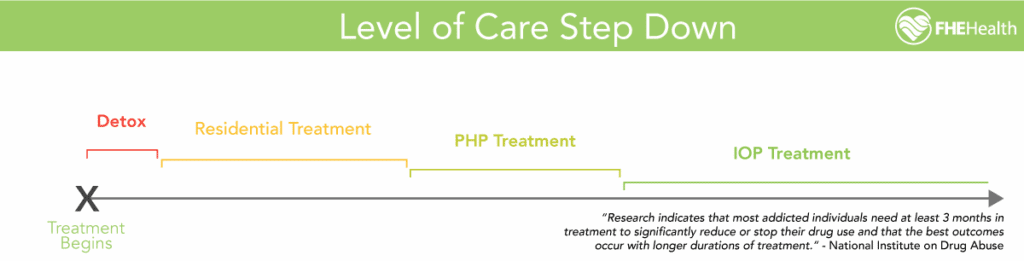
At FHE Health, we accept patients at all levels of care we offer, but the most effective treatment takes place when clients move through each level from start to finish. FHE Health provides services across the ASAM continuum, from the highest acuity levels (medically managed intensive services) through detox, residential, PHP, IOP, and outpatient, meeting each patient at the level of care their situation requires.


FHE Health Levels of Care
At FHE Health in Deerfield Beach, Florida, we offer a personalized continuum of care. We assess the risk factors and unique needs of each client and build a recovery schedule that begins with the most intensive levels of treatment we provide — medically supervised detox and intensive residential care, with 24/7 medical and clinical support — and steps down through outpatient services as clients build the skills and stability needed for independent recovery. If and when relapse occurs — NIDA reports that the relapse rate for addiction is between 40 and 60 percent — we re-engage clients at the appropriate level of care, often beginning again with medically supervised detox. Here are the services we offer at each level:
Medical Detox
The continuum of care begins with the process of safely detoxing clients from drugs and alcohol. Successful therapy and rehabilitation can occur only when the body is free of its physical need for a substance. At FHE Health, we have a staff of addiction medicine doctors, registered nurses, and licensed therapists prepared to oversee the process and manage medications when necessary, with 24/7 medical supervision throughout.
Residential Treatment
Upon arrival at our residential facility, each patient is assigned to one of our specialty programs as appropriate. This designation depends on an in-depth assessment of the patient’s needs as well as quantifiable measurements from our Neuro Rehabilitative services. A personalized plan for each patient improves not just the completion rates of our programs but also the long-term success for every patient.
Outpatient Care
We offer PHP and IOP for clients who have completed our residential programs. PHP clients may continue residing in our supportive on-campus housing, providing a structured living environment in close proximity to outpatient therapy. While attending PHP, clients are given their first re-exposure to normal life. They frequently visit our facility for continued outpatient therapy, often seeing the same therapists and support groups, and they begin using the learned skills for managing emotions and processing external stressors as they take on responsibilities. In our gender-separate housing, men and women focus on their recovery without the stressors of their home environment, which may have contributed to their behavioral health issues. In IOP, less time is spent in therapy sessions, and we facilitate job searches and encourage clients to take on more responsibility where possible. IOP clients who reside on campus do so through our supportive housing arrangement, which operates alongside — not as part of — the clinical service.
Alumni and Aftercare
FHE Health offers a strong alumni support system and aftercare options that include continued group meetings like those in NA and AA, as well as therapy sessions that continue long after clients have completed our residential programs.
Recovery from addiction is rarely a straight line, and the continuum of care exists because lasting recovery requires more than any single phase of treatment can offer. At FHE Health in Deerfield Beach, we work with each client to build a personalized path through the levels of care — meeting them where they are and supporting them all the way through. To learn more about how our continuum can be tailored to your situation or a loved one’s, contact our admissions team for a confidential conversation.
Start the admission process
100% free and confidential insurance verification with a counselor
FAQs About the Continuum of Care at FHE Health
Begin Your Recovery Today
Begin your recovery today
Ready to start? More questions about treatment?