
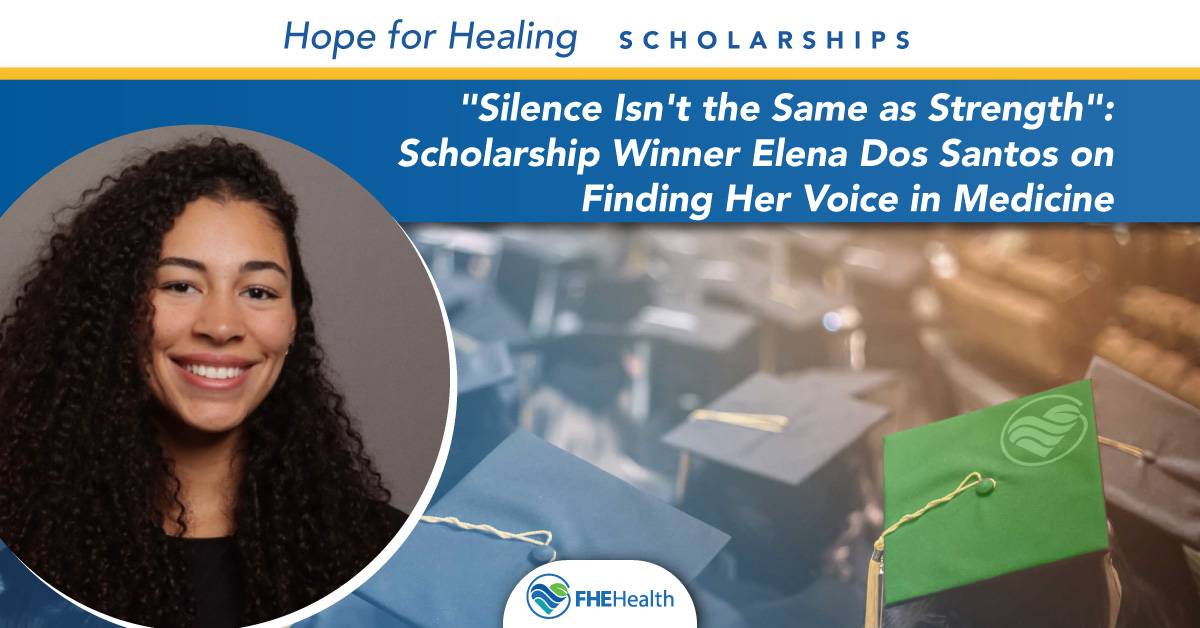
- Elena Dos Santos is the 2026 Hope for Healing Scholarship winner, pursuing a pre-med degree in neuroscience at Geisel School of Medicine at Dartmouth.
- Elena immigrated from Brazil at age 10 without speaking English, spending years in near-total silence before finding her footing through STEM.
- Her work as an EMT revealed a gap she wants to spend her career closing: the distance between what medicine can measure and what patients are actually feeling.
- She conducts research in a Veterans Affairs lab studying blast-induced brain trauma, work she hopes will eventually help veterans feel like themselves again.
- Elena plans to practice in underserved communities and mentor first-generation students — carrying her family’s story into every classroom, lab and patient encounter.
When she moved from Brazil to the United States, 10-year-old Elena Dos Santos didn’t speak a word of English. For about 3 years, she couldn’t understand her teacher or her classmates, leaving her in “8 hours of silence a day.” Today, that same quiet student is the recipient of a competitive scholarship, not only because of her academic achievements, but due to her passion for paying it forward.
Brazil to Bridgeport: A Big Bet Pays Off
Elena’s story of resilience and determination began with her mom. Life in Brazil had become increasingly difficult, so her mother gathered the courage to begin the immigration process. Every cent they had went into obtaining visas, leaving Elena’s family with few resources when they finally arrived in the United States.
While her mother cleaned houses, Elena attended school, but no one else spoke Portuguese. She developed an interest in STEM early on, mostly because it was the one thing that made sense. “Numbers are the same in every country,” so math and science felt familiar to her when history and literature didn’t.
Logic Becomes a Lifeline
That early connection to STEM wasn’t just about comfort; it would completely transform her life. As a pre-med student at Dartmouth College, she’s studying neuroscience, a field that gives her something her early years in the United States didn’t: language for what she experienced.
Elena says that when she learned what chronic stress actually does to the brain, “I couldn’t help but think about my mom. Of the way she’d lose patience when my dad missed another day of work because he was ‘tired.’ Of the fact that she never said she was struggling, because she couldn’t afford to be. Now that I think about it, science gave me the words to name something my family never had words for.”
Studying neuroscience has also changed the way Elena thinks about mental health. As a child, her mother had a simple philosophy: “Save your tears for your pillow.” Now that she understands the nervous system better, Elena understands that “silence isn’t the same as strength.”
Heeding the Call
That idea became even clearer during her work as an emergency medical technician. She arrived at a call to find a man sitting alone in a dark apartment, barely speaking. His vital signs were stable, so he didn’t meet the criteria for transport. Elena and her colleagues left, but she couldn’t stop thinking about him.
“He didn’t need an IV,” she said. “He needed someone to sit with him in that silence. To acknowledge that something heavy was happening in that room, even if it didn’t show up on a monitor.”
That experience revealed a major gap in medicine. There’s only so much a stethoscope, a CT scanner or an EKG machine can measure. These tools are incredible, but they can’t quantify what patients are actually feeling. Once she was aware of this gap, Elena decided to pursue a career in medicine. “I’m going to be dealing with this as a doctor,” she vowed. “The invisible pain.”
Trauma in the Tissue
At Dartmouth, Elena is balancing a demanding course load with two jobs and research in a Veterans Affairs lab focused on blast-induced brain trauma. Her days often involve running behavioral assays on mice that have been exposed to repeated shockwave injuries, which are similar to the blast trauma sustained by many veterans.
“What surprised me most is how much I love the detail of it,” she revealed. “Knowing that what you’re looking at might eventually help someone feel like themselves again” matters.
The work has also deepened Elena’s understanding of trauma, especially in communities with limited access to quality healthcare. She acknowledges, “These injuries don’t end when someone comes home. The brain carries them forward.”
Celebrating a Generational Milestone
Getting into Dartmouth was a milestone that still seems surreal. Elena remembers that she had to explain to her family what an Ivy League school was. “They didn’t know.” Her mother, who rarely shows emotion, started crying. That moment meant everything to Elena.
Redefining the Role of a Doctor
Studying at Dartmouth is more than just a personal achievement. Her experiences at home, in the classroom and in the field have helped Elena redefine what it might mean to be a doctor. Her philosophy is that it starts with listening, “not just waiting for the symptom that confirms your working diagnosis.”
Elena wants to work with patients who don’t necessarily have the language to describe what they’re experiencing, particularly those with immigrant backgrounds like her own. Mental health is often stigmatized or misunderstood, causing patients to say they’re fine when they’re not. Elena believes that a good doctor “learns to read that gap.”
She’s also passionate about improving systems of care, especially when it comes to access and follow-up. “Dismissing invisible pain isn’t always intentional,” she explains. “Sometimes it’s a result of a lack of resources or the way the system works. That’s something I want to be part of changing, in the clinic and even beyond it.”
Breaking Barriers and Building Trust
In many communities, including Elena’s, conversations around mental health are difficult. “The belief that struggling in silence is strength, that asking for help is weakness, that mental illness means you’re broken — those ideas are deeply embedded,” Elena says, “People need to see doctors and mental health professionals who look like them, who speak their language, who understand the particular weight of building a life in a country that wasn’t always built for you.”
That’s where she sees herself contributing. “Not by showing up with all the answers, but by showing up as someone who came from that same silence and found a way through it.” She hopes to practice in an underserved community, helping to normalize difficult conversations.
Building a Better Future
Elena’s professional goal is to become a physician and practice at the intersection of neuroscience and mental health. She also wants to give her mother a better life. It was her mom who had the courage to start the immigration process, and that courage allowed Elena to pursue her dreams. “She sacrificed more than I can repay,” Elena acknowledges. “Being able to ease even a fraction of that would mean everything for me.”
She also plans to return to Bridgeport, Connecticut, to mentor students who may not see a path to medicine or some other type of higher education. Many undocumented and first-generation students believe there’s no way for them to attend college or pursue their professional goals. According to Elena, “That perception is real, and it’s one of the most limiting things I’ve seen in my community. I want to be the proof that disrupts it.”
“You’re Allowed to Struggle”
For people coming from similar backgrounds, Elena’s message is deeply personal. “You’re allowed to struggle,” she advises. It’s a lesson she learned over time, through 3 years of silence, a newfound love of science and the realization that the strongest voices are the ones that often go unheard.
“I didn’t get here alone,” she said. “I got here because of my mother, who left everything she knew and bet her entire world on a chance that her daughters could have a better life.” As she moves closer to a rewarding career in medicine, Elena plans to carry her family’s story into every classroom, every lab and every patient encounter.